Pages

Friday, September 7, 2012

More golfers are using our forward tees

More and more golfers at Glendale CC are using our forward (Gold) tees. When they were built about ten years ago, NOBODY used them. The membership thought it was a total waste of money spent on the project. As time went on, some of the ladies nine hole players tried them and really liked the shorter yardages. Then some senior men and junior players moved up and continued to use them also. This past year the USGA has been pushing their "Tee it forward" campaign. They are trying to get more people to play the golf course from yardages that are more suited for their ability. I'm a single digit player but don't enjoy playing a 7,200 yard course and getting my lunch handed to me. I'd much rather play from 6,700 yards or shorter and have a good time. It's no fun hitting fairway woods and long irons into every par 4 on the course.
 Since our gold tee boxes were never designed for the amount of rounds they are getting, some of them need to be enlarged. The photo below is of the gold tee on #7. Check out the amount of divots on this tee, and it's a par 5 where golfers are teeing off with a driver.
 
More rounds cause more divots to be taken. Since the tees are too small, all of the divots occur in a small area at the center of the tee. As our crew continues to fill in these divots each day, that area gets raised up over time and creates a crown in the center of the tee. Check out the photo below of #6 gold tee and look at the raised area between the markers. Sometime this fall or winter we are going to have to take the sod cutter and cut the sod off the tee, level it out, and put the sod back.  We sure never have a shortage of projects on the golf course!                

Monday, August 13, 2012

When can we hit off the grass?

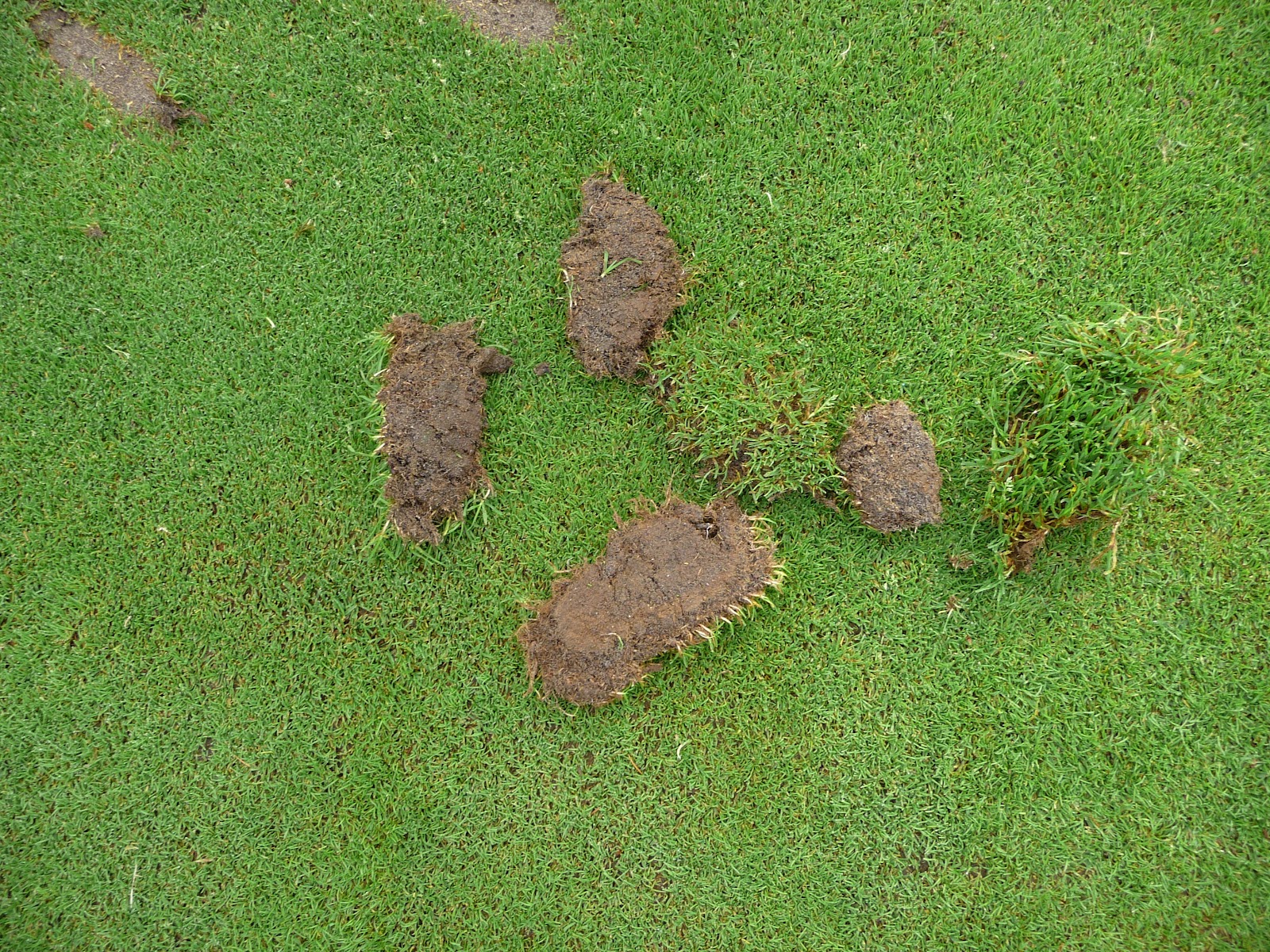
I get asked all the time why can't we hit off the grass on the driving range tee. The photo below was taken today after using the tee for the weekend. Our driving range is not long enough to hit off the front of the tee, too many balls go over the fence. So, we are restricted to use only the back of the tee. The small area of the tee that is usable can only handle a couple events per year. It will take about a month for this war zone to recover, so it's not fit for play in the mean time.

Friday, August 3, 2012

Where oh where do all our range balls go?

We lose a lot of range balls every year at Glendale. The soil on the driving range is all blue clay, and it gets really soft in wet weather. We did a drainage project on the range about seven years ago and it worked well. But we still lose balls.
During the junior golf camp last week we set up a four hole short course on the driving range. I used a six inch cup for one of the holes to make it easier for the kids. Check out the photo below. I cut a six inch hole ten inches deep. Not a lot of square footage I dug up. I found 17 old range balls in that small hole. Just think how many balls are under the surface just waiting to be found. Too bad there isn't a market for old golf balls, we'd make a small fortune!

Tuesday, July 17, 2012

Lemon Joy dish soap spells tournament time


Summer showed up one day early this year, arriving on July 4th instead of the usual July 5th. We just had our men's member-guest event at Glendale, which is our largest member tournament of the season. One of the things we do in preparation of the tournament is to spray our fairways, tees, and approaches with Lemon Joy dish soap. I know this sounds crazy, but when mixed with some iron and fertilizer, it makes the sprayed areas shine. We combine 12 ounces of soap, 4 ounces of iron, and .10lb of nitrogen fertilizer in 1.5 gallons of water, and spray that rate per 1000 square feet of turf. In total, we spray 150 gallons of soap.

The spray tank holds 300 gallons,
so we first fill it about 3/4 full of water. Then add the liquid fertilizer and iron, the soap is added last. Since the mixture in the tank is constantly stirred with air agitators, we have to use a product called "No Foam" to prevent the soap from producing lots of foam.
As soon as the tank mixture is sprayed, you can see the shine from the soap. The photo below is taken from #18 fairway looking down to #17 fairway that is one half sprayed. Look how the sprayed area is so much darker in color than the non sprayed fairway. It takes until the next day for the turf to show the color of the added iron and nitrogen fertilizer. After 24 hours, the effect of the three products combined is stunning.
When the sun is shining on the sprayed areas, you have never seen shining power green color like this before. We mow the fairways with a right and left pattern, and when the color of the light and dark mow lines jumps off the suface and hits your eyes, all you can say is WOW! For a big event, you want the golfers to get something extra from their golf experience, and this is it. The color lasts for about five to seven days, but during that time, it doesn't get any better than this.

Monday, July 2, 2012

Divot Police on Patrol


The Glendale divot police are on patrol looking for players who don't replace their divots. Take a look at the photo below and notice that there are three large divots that were filled with sand/seed mix. Also notice that fifteen feet ahead are the three large chunks of sod laying on the fairway. Why didn't the golfers replace their divots? Yes, they filled the holes with seed mix, but that will take at least two weeks to grow back and fill in the hole.

The divots were also overfilled with sand, which kills fairway mower blades and bed knives which are expensive to replace.


The photos below show some of the 136 divots I picked up from the 14th fairway today ( Monday, after a busy weekend). We sent out five guys this morning to pick up divots, and it took them 40 minutes each. That's 3.33 man hours to do the golfers job. These divots have to be picked up by the maintenance crew before we mow the fairways, or the mowers take a beating. It also looks very messy after the fairway mower chops up the divots and spits small pieces all over the fairway.
   I realize that some divots explode into a bunch of small pieces that are not practical to replace. That's the time to fill the hole with sand/seed mix. The photo belows shows a divot I took on 14 fairway. I used a sand wedge and swung as hard as I could. I tore up a sustantial piece of sod.
The next two photos show the divot before and after it was replaced. Look how nice it looks after replacement. You can hardly see a divot was taken.

If you've followed along this far, you can see that replacing the piece of sod is the correct method when filling a divot. I'll make sure that the Pro Shop informs all outside tournament golfers to replace their divots. If we can get the message out to our members to replace divots, we'll be on the way to really improving the condition of our course. If not, watch out for the Divot Police. They'll be on patrol writing citations for failure to replace divots, and all other infractions of golf course etiquitte!

Monday, June 18, 2012

Golfer responsibility checklist

What looks out of place in this photo? If you look closely, you can see that there are 32 broken tees laying on the turf on and around the tee markers. There is a box conveniently located on all of the par 3's to place broken tees, but they are not used much. The maintenance staff here at Glendale spends a lot of time picking up broken tees around the teeing area every day. This should be the golfer's responsibility, just like replacing divots and repairing ball marks. Also shown in the photo are divots taken but not filled. There is a bucket of divot mix on all of the par 3 tees. Our staff also fills many divots on teeing areas everyday which can also be done by the golfer. These house keeping items are done by our staff, but should be done by the golfer. This leads me to think of the other things a golfer should be doing each time they play a round, whether here or any other golf course. We as golfers need to respect the other players on the course, the course itself, and the game of golf too. Listed below is my golfers responsibility checklist. Look it over, and see how many things you are doing each round to help keep Glendale in nice condition.
1. Replace every divot you take. If you can't replace it, fill it in with sand/seed mix.
2. Repair every ball mark you make on a green.
3. Rake your footprints in bunkers, and place the rake along the backside of the bunker.
4. Please don't litter. Place all trash in appropriate containers, and pick up your broken tees.
5. Please keep power carts on the path around tees and greens.
6. Our fairways are much firmer and drier than than the rough areas, so please keep power carts on fairways in wet weather.

By following these six rules, you will help keep our course in good condition, cut down on maintenance by our staff, and make each round of golf more enjoyable for every player at Glendale CC.
Thanks for your help!

Thursday, June 14, 2012

Tree or bunker in wrong place?

Trees and bunkers don't get along very well together. Bunkers are hazards on a golf course to penalize a bad shot. A successful shot hit from a bunker is hard enough just hitting off a good lie. Could you hit that same shot from a lie on the sand sitting on top of a one inch wide tree root? I would call that situation double trouble. Chances are that if you hit a drive into one of our fairway bunkers at Glendale, your ball will be resting on top of a tree root just under the surface of the sand. We have six fairway bunkers at Glendale, located on holes 4, 5, and 8. Each one of these bunkers is full of roots just below the surface of the sand, coming from an adjacent tree. These trees are too close to the bunkers. Keeping tree roots out of the bunkers is impossible to maintain. We can pull them out, but we'll miss some and more will be back soon. The real problem is golfer safety. Someone could easily get hurt if their club catches a root while hitting a shot. Check out the photo below of the root in the fairway bunker on the 5th hole. This is typical of the roots found in our bunkers.
The next photo below shows the roots we removed from a small area in the left corner of the left side fairway bunker, on the 4th hole.
A weed is defined as a plant out of place. A tomato plant in a corn field is a weed, and so is a tree in a bunker. In this case the trees are out of place, and in my opinion, the only long term solution is to remove the trees due to the safety issues they create. This issue will be brought up and discussed at the next Green Committee meeting, on July 18, 2012.