Pages

Wednesday, April 16, 2014

Trees -VS- Turf continued........

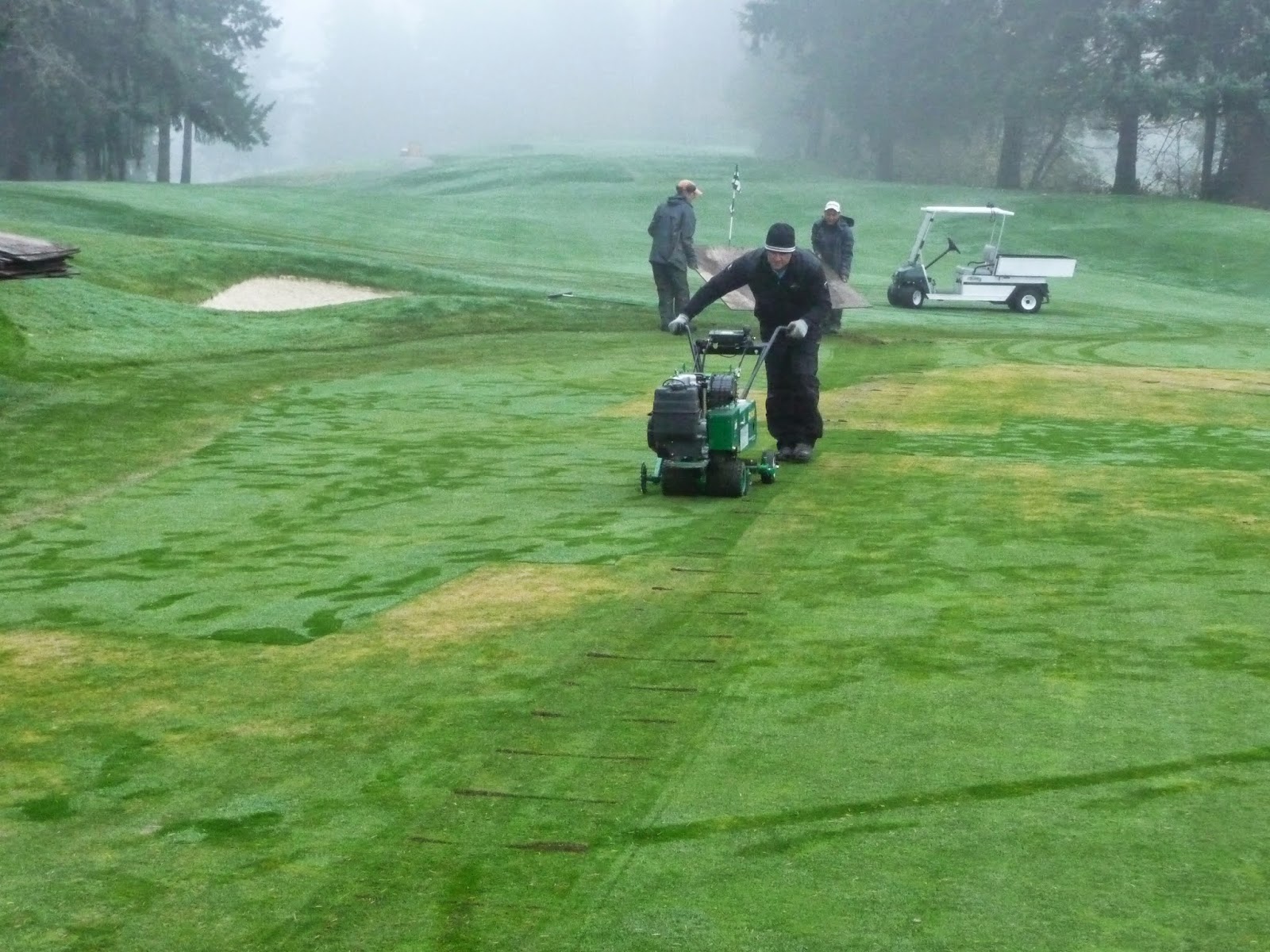
The three photos below were taken Monday April 14th at 3:00 pm. It was a beautiful sunny day, 68 degrees and perfect weather to aerate greens. The reason I show the photos is to see if you get the same feeling as I did when I drove up to the 12th and 15th greens. The amount of daylight we had on April 14th is the same as we'll get on August 28th. The first photo shows #14 green. 
The green is in full sun. I rolled up to check out this green with the sun in my face and I'm feeling great. Despite just getting aerated and sanded, the turf is happy too. 
I then headed over to #12 green to check it out. 
The green is shaded, but the trees are in full sun. Hmmmmm?  I drove over to #15 next.
Wow. Bright sunny day and it feels like stepping into a closet. Turn on the lights please! Decreased light equals decreased turf quality. You get the idea now of what caused the 15th green to fail in November of 2012, just 17 months ago. I like trees, but not next to greens where the turf suffers. In the battle of Trees -VS- Turf, the trees win every time. 

Wednesday, April 9, 2014

Trees -VS- Turf, who's the winner?

Trees are an integral part of most golf courses in the Pacific Northwest. When managed properly, they can co-exist with turf most of the time. The taller the turf, the better it gets along with trees. Tees and greens are the areas that don't like competition from trees for light and water. Short cut turf = short roots and the trees win the battle every time. The photos below were taken last week and show the left side of #12 green. Several members have asked me lately why the green has shrunk in size in that area. Over the past winter, the edge of the green was moved in (four feet at the mid point) because of stress caused by the big tree in front, and the other big one just off the left side of the green. This area becomes thin and turns to mud if we continue to mow it through the winter. It's full of tree roots competing with the turf for food and water, and the turf checks out for winter due to the lack of sunlight caused by the trees. Fungal diseases (especially cool season Pythium) are a problem from October through March due to the shade, so extra fungicide applications are made to this green.
Sixteen months ago the turf on the 15th green started showing severe signs of stress. We had done our fall aeration in early September and the green was not looking good (Fall aeration causes a lot of stress on weak shaded greens.) We babied it along for the next month, and in mid-October sprayed all the greens with a fungicide as part of our normal disease prevention program. The turf did not like the added stress from the fungicide application and took a turn for the worse. We re-sodded sections of the green, but the rest was getting worse. It got a case of cool season Pythium and that was all it took to push it over the edge. Here is a photo below of what it looked like on November 6, 2012. 
I was so disgusted by the condition of the turf that I decided we needed to replace the entire green. You can see my cart tracks where burned some rubber on the dead grass. That was my final goodbye to the past two months of stress I dealt with  over the condition of this green. 
Back to the shop for the sod cutter, and time to get to work.
The entire green was cut, cleared, and hauled off  to our compost pile. The sod we had been growing at the nursery on the 3rd hole was in perfect condition. It was built with greens aeration cores that I got from Seattle Golf Club the year before. We laid the new green in two days and it looked great. It was opened for play in three weeks and still looks good today. The only issue we still have with this green is the stress that caused the initial problems is still present. I can't guarantee that sometime in the future we have another turf failure. The photo below was take at 12:30 pm on November 7th, 2012. This green has shade over 1/3rd of the green at the time of day when the sun is at it highest point. At 2:00 pm it was completely covered in shade. This fall we plan to have Arborcom do shade analysis on both #12 and #15 greens. We'll take their recommendations and remove trees that are necessary to get the light needed to grow healthy turf. This time next year we should have more light on the greens and be confident that they will perform like the rest of the greens on the course.

Friday, April 4, 2014

Soil temps, growth regulators, and height of cut.

Spring is officially here and the turf is starting to wake up from a long winter nap. The soil temps are warming up slightly and growth on greens is slowly increasing day to day. The photo below shows the soil  temperature at a depth of 1 1/2" on the putting green is 50 degrees.
The color of the turf on greens is slightly off due to application of two different growth regulators in the month. We use a product called Proxy to suppress seed head development which was applied three weeks ago, and we'll follow up with a second application next week. This should keep the seed head numbers very low to none at all. It has a slight growth regulating effect and turns the turf a little off color. Two weeks ago we made our first application of the year of a product called Primo, which  causes the plant to grow laterally, not vertically. It causes the turf to become much denser because the plant puts all it's energy into lateral growth. We apply it for the entire season until it gets cold and wet in October. Our first Primo application always causes the turf to turn slightly yellow as you see in the photo below.
The color on the greens will improve in the next week as the turf gets used to living with the Primo. The height of cut on greens was lowered yesterday from our winter cutting height of .130 to .115. That is the thickness of four sheets of printer paper shown below. After spring aeration we will make our way down another 15 thousandths of an inch to our summer cutting height of .100.
The thickness of four sheets is actually 14 and 1/2 thousandths (.0145) not 15, but very, very close. We set the height of cut on our greens mowers with a gauge in the shop. In the field we check the actual cutting height with a prism gauge shown below.
The angle in the photo is not quite right, but if you look closely you can see that the height of cut is under .125 (an eighth of an inch). This shows that the bench setting and the actual height of cut are very close. 

Tuesday, April 1, 2014

Golf course updates for the week of 4/1/2014

Today's post will give an update of various things that are happening on the golf course. We removed a lot of Japanese Knotweed from along the creek on holes 6, 7, and 8 last fall. I like the look of the exposed creek,  and this season we are going to do our best to keep the Knotweed from taking over those areas. The photo below was taken last Friday and shows the Knotweed waking up from winter. Small plants have emerged all along the creek and soon it will be  time to make our first herbicide application. 
We can spray most of the plants close to the stream, but some of them are right along the edge and we can't get the spray mixture into the water. Those plants will have to be dealt with by other methods yet to be determined. The area shown below is between the walk bridge over the creek on #7 and the 8th tee. While this area does not look very attractive, at least it's better than twelve foot high Knotweed. 
All of the benches have been refinished and are back out on the course. Thanks to Deane Austin from our staff who spent two months over the winter doing the work.
New mats are here and were put out on the driving range tee this morning. 
We have just started the process of replacing all 192 green side sprinkler heads. Each head takes about 45 minutes to dig up and replace. The new heads offer several advantages to the 21 year old heads they are replacing. New nozzle technology produces a better spray pattern distribution, adjustable arcs, improved electronic valves to turn them on and off, and increased height when they pop up upon being turned on. 
In an effort to clean up the look of the course a little bit, all of the hazard and OB stakes are being replaced for opening day. Some of them were looking very tattered and bleached out from the sun.
Most of our time is currently being spent on mowing long grass. It's still very wet in some areas and we've gotten several mowers stuck in the mud today. Hopefully things will dry out soon so we can get the course in shape the golf season.

Friday, March 14, 2014

High water in Kelsey Creek causes more bank erosion

The recent wet weather has has caused some more erosion along the banks of Kelsey Creek. The worst damage has occurred along the areas where the City of Bellevue did in-stream work last summer. I met with the city inspector who is assigned to the job and  we looked at the areas this morning. He took photos and will meet with City of Bellevue Storm and Surface Water engineers next week to see what can be done temporarily limit further damage. A long term solution will require more engineering, permits, and review by all of the governmental agencies that have jurisdiction over the stream. 
The photo above is along the 8th fairway about 175 yards from the green. This erosion occurred last weekend. 

Further erosion along the 8th tee. I'm not an engineer, but I could see that when all of this large woody debris was installed, the water would be diverted around it. A common sense solution would be to remove some of the stumps and let the flow stay in the channel, not make a new channel. Sometimes common sense is not so common.
West side of the creek on the 16th hole looking downstream.
East side of the stream directly across from the area in the last photo on 16. The City has hired a landscape contractor to maintain this planted area on 16 (for the next five years!). They will be replacing plants as needed, weeding (I can't wait to see how they manage all the Canarygrass and Knotweed) and general maintenance. 

Thursday, March 13, 2014

Green-side irrigation head replacements underway

Part of our irrigation system upgrades for 2014 include replacement of all the green-side sprinkler heads. Each green has either 4, 5, or 6 full circle heads that water the green depending on it's size. There are also 4 or 5 part circle heads that are aimed away from the green that water the area around each green. We have a total of 192 heads to replace in the next month, each one taking about 45 minutes to change out.
The photo above shows Tim and Frank working on head relocation around #18 green. The 18th has been our most challenging green to maintain during the summer months. When it gets hot and the days are long in July, it requires a lot of hand watering to keep it from getting cooked. Since it was time to replace the green-side heads, we did some measuring on the sprinkler head spacing and found that we needed to make some changes. We found that there were three heads that were spaced too far apart causing a zone in the middle of the green that did not get adequate coverage. Tim and Frank figured out the best location for the heads and moved them to those spots. I'll report back this summer on the success of the changes we made to the head locations. Hopefully the better coverage will reduce the amount of daily hand watering required  on this green.   

Friday, March 7, 2014

Drainage next to #10 green

Recently we noticed the area behind and to the left of #10 green was getting very wet and muddy. This was a red flag since there had been no rainfall in over a week. We searched the area for clues as to where there was a possible irrigation or drainage issue, and found a small trickle of water coming up through the turf behind the green. 
We used the hose you see in the photo to try to clean out the exit line from the drain box shown at the bottom of the photo. No such luck. We ran a snake down the exit line and it got stuck about 25 feet from the box. Time to start digging. We dug a hole behind the green, found the line, and kept digging along the pipe until we found a section that was crushed. 
The pipe was installed twenty years ago when the green was built. It's amazing that it was able to run water all that time. Why did it get backed up now? We dug up the crushed section and put a snake in it and found the line crushed again another thee feet down.

 It was time to dig from the box all the way out and across the cart path behind #10 green. 

We also added a new section of drain line along the hill into the box. A new line was also installed from the box across the path discharging over the back of the road. We'll closely monitor this area to make sure it's working over the next several months.